


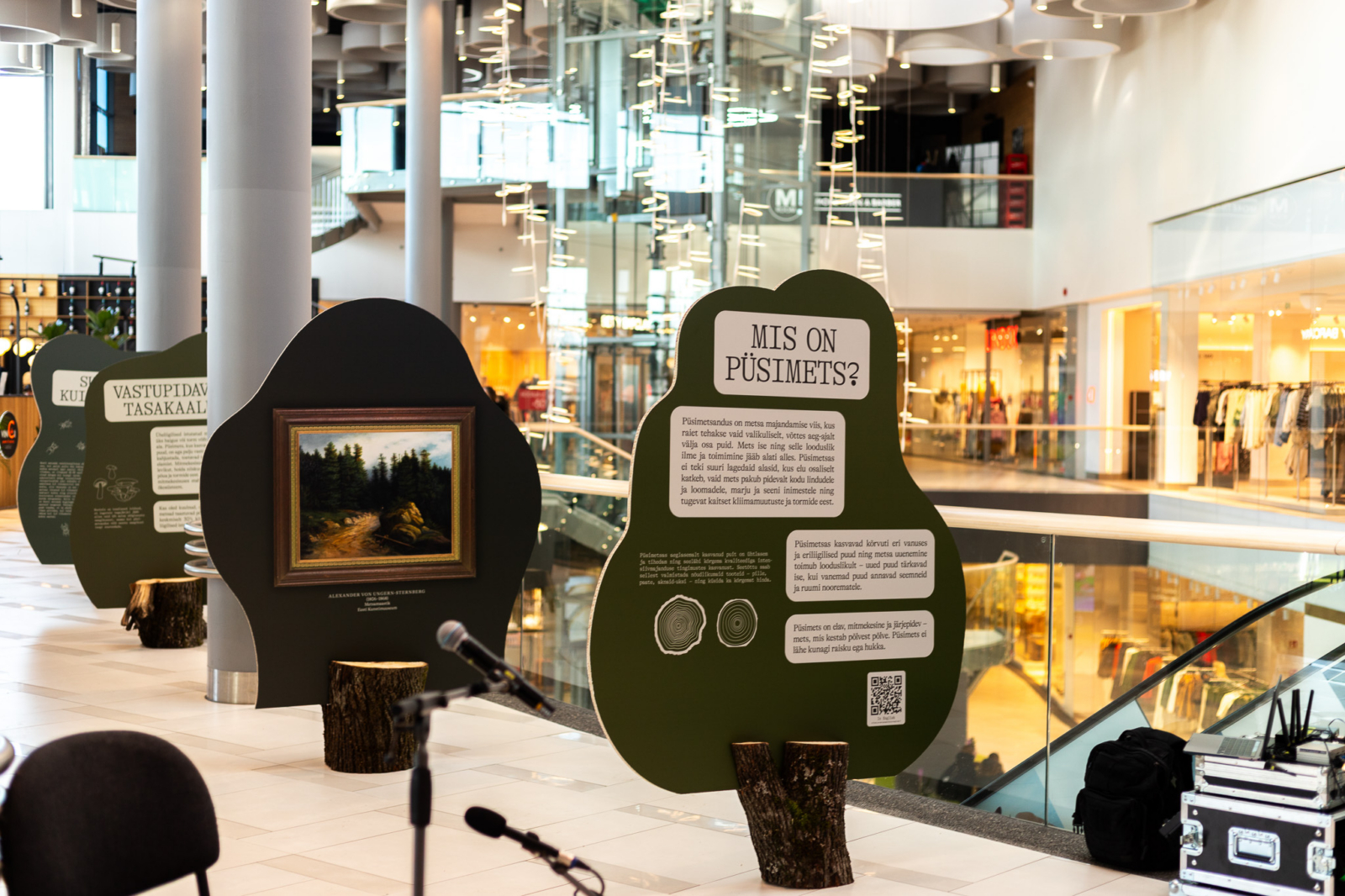
Today, the exhibition For the Forest to Endure (Et mets püsiks!) opened at Ülemiste Centre, becoming the first exhibition in Estonia aimed at a broad audience dedicated to continuous cover forestry. This refers to a nature-friendly method of forest management that does not employ clear-cutting.
A gallery from the exhibition opening is available here (photographer: Katre Liiv).
Prepared on the initiative of the Estonian Fund for Nature, the exhibition brings together the golden treasury of Estonian painting with contemporary knowledge about forest ecosystems, creating a unique point of contact between science and art. Through educational texts and quantitative examples, the display explains the role of continuous forestry in preserving biodiversity, sequestering carbon, and ensuring the resilience of forests.
Silvia Lotman, Member of the Board of the Estonian Fund for Nature, noted that unfortunately, for many people forest logging has come to be associated exclusively with clear-cutting and the disappearance of forests: “With this exhibition, we want to show that there is another path – one where the forest remains a forest, biodiversity is preserved, and the forest owner also receives income. The forest landscapes of classical artists help us understand how deeply the forest is rooted in the identity of Estonians.”
“Continuous cover forestry is not merely one method of management – it is a way of thinking that allows us to live together with the forest rather than exploit it,” said long-time practitioner of continuous cover forest management Rainer Kuuba at the exhibition opening. “A continuous forest will make it possible for our children and grandchildren to harvest timber regularly and sustainably.”
Antti Tooming, Deputy Secretary General of the Ministry of Climate, emphasized that Estonia’s forest policy supports environmental objectives alongside economic interests. “Continuous cover forestry is one way to diversify forest management methods, which is why it is important to pilot it on a scientific basis. This requires research to assess continuous forest management practices, including harvesting methods and natural forest regeneration,” said Tooming. “In addition, starting July 1, the Environmental Investment Centre will begin providing support for the preparation of forest management plans within the framework of continuous forestry, should a forest owner wish to test it on their land.”
Guido Pärnits, Head of Ülemiste Centre, noted that the values and areas of activity of the Estonian Fund for Nature are very close to those of the centre. “Sustainable forest management and conscious environmental stewardship are themes through which we can value and preserve Estonia’s environment and nature – in other words, support precisely those directions that are also key values of Ülemiste Centre,” Pärnits emphasized. “It is important that more attention is paid in Estonia to the development of knowledge and skills supporting continuous cover forestry, and the exhibition at Ülemiste Centre – a place visited daily by a large number of people – provides an excellent opportunity for this.”
The exhibition’s curator, Rael Artel, selected works by classics of Estonian art that create a bridge between cultural history and nature conservation.
The exhibition will remain open in the atrium on the second floor of Ülemiste Centre until the end of August. The display was prepared on the initiative of the Estonian Fund for Nature with the support of Ülemiste Centre.


